
Fiscal Year
The U.S. federal government closes its books for fiscal year 2026 on September 30, 2026, three months before the calendar year ends. That gap is the fiscal year meaning in practice: a twelve month accounting period used for financial reporting, budgeting and tax returns that can start on any date instead of January 1.
Fiscal Year in USA Explained
In the U.S., a fiscal year is any twelve month period an organization picks for its books, and the label usually carries the year in which it ends. The federal fiscal year USA runs from October 1 to September 30, so FY 2026 covers October 1, 2025 to September 30, 2026. That is what FY in USA most often points to. Some companies label their year by the year it begins, so check how a company names its own periods.
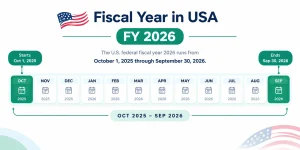
The end of financial year USA is not a single date. Federal agencies close on September 30, individuals and many small businesses close on December 31, and other companies choose their own. “Financial year” is the wording used in Australia and the UK, while U.S. sources say fiscal year.
Common Fiscal Year Examples
Each fiscal year example below follows the organization’s own business cycle.
| Organization | Fiscal year runs | Reason |
|---|---|---|
| U.S. federal government | Oct 1 to Sep 30 | Budget process finishes before the new year opens |
| Walmart and many retailers | Feb 1 to Jan 31 | Holiday sales and January returns land in one year |
| Apple | Ends in September | Device launches and the holiday quarter share a year |
| Microsoft | Jul 1 to Jun 30 | Fits software purchasing and education budgets |
| Schools and many nonprofits | Jul 1 to Jun 30 | Follows the academic calendar or grant cycles |
Fiscal Year vs Calendar Year: Know The Difference
The difference between fiscal and calendar year is the start date. A calendar year always runs January 1 to December 31. A fiscal year is any twelve consecutive months, beginning on the first of any month or, less often, partway through one.
In the fiscal vs calendar year choice, the calendar year is simpler to track and lines up with personal tax filing. A fiscal year earns its place when revenue is seasonal. A shop that earns most of its money in November and December would rather close its books in January than in the middle of its busiest stretch.
Benefits of Fiscal Year for Businesses
Ending the year after the peak season puts one full sales cycle into one set of statements. That brings a few practical gains:
- Cleaner year over year comparisons, because each year mirrors the operating cycle
- More room for tax planning, such as timing income and large purchases
- Easier access to an accountant, since a year end outside January to April avoids the busiest weeks
- Cash on hand after the peak season to cover the tax bill
IRS Requirements for Fiscal Years
The IRS limits who can use a fiscal year, and the limit depends on entity type.
| Entity | Tax year rule | Return due |
|---|---|---|
| Individuals and sole proprietors | Calendar year | April 15 |
| S corporations and partnerships | Calendar year, unless a valid business purpose supports another | 15th day of the 3rd month after year end |
| C corporations | Free to choose | 15th day of the 4th month after year end |
A business that wants to switch must file Form 1128 with the IRS. The stretch between the old year end and the new one becomes a short tax year, which needs its own return.
Bottom Line
A fiscal year is an accounting choice with tax consequences. For FY 2026, the federal books close on September 30 and FY 2027 opens on October 1. For a business, the best fiscal year end date usually falls just after the busiest season, provided the entity type allows it. Confirm the rules with an accountant before filing Form 1128.