 +1 (347) 781-5928
 +61 (485) 921-100
 +44 (7700) 170-900
1099 tax calculator:How to calculate what you actually owe
You landed a contract, money hit your account, and now you’re wondering how much of it is actually yours. Enter what you earned and spent, and get your real federal income tax, self-employment tax, and quarterly set-aside.
Total estimated tax owed
Effective tax rate
Net profit
Self-employment tax
Federal income tax (est.)
Quarterly payment
This free service is for illustrative purposes as-is without warranties. If you intend to rely on these rates, please contact Global FPO Tax expert for free.
What this 1099 tax calculator actually tells you
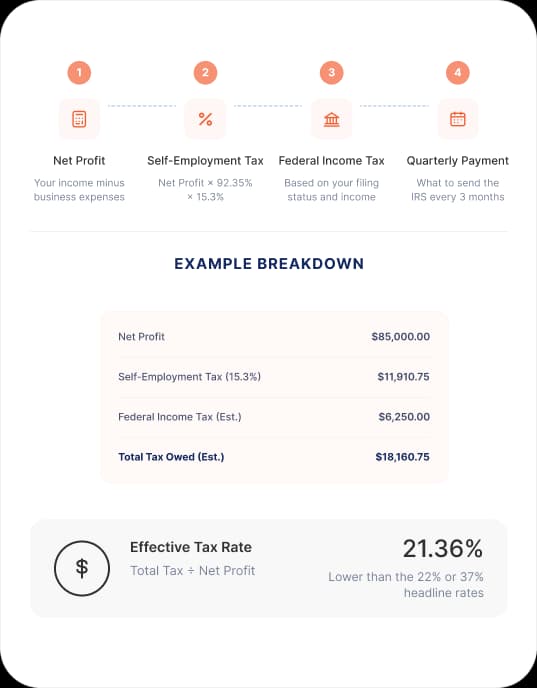
Most free tools spit out one number and leave you guessing how they got there. This one breaks it into the four pieces that actually matter:
Because the rate applies to net earnings rather than total revenue, the amount you actually owe depends entirely on your profit, not your income. Business expenses, filing status, and other income can all shift what you end up owing:
Self-Employment Tax = Net Profit × 92.35% × 15.3%
- Self-employment tax: the 15.3% that catches almost every first-year freelancer off guard
- Federal income tax: the two above, added up
- Your quarterly payment: what to send the IRS every three months so April isn’t a disaster
Punch in your income, subtract what you spent running your business, and the calculator does the rest — no signup, no credit card, no email wall. It’s built for people paid on 1099s, not a generic paycheck calculator repurposed for freelancers.
It also shows your effective tax rate, which is almost always lower than the bracket number that scares people — brackets are marginal, so only the dollars inside each band get taxed at that band’s rate. On a typical $85,000 net profit, that usually works out closer to 21% than the 22% or 37% figures headlines throw around.
How To Calculate 1099 Tax
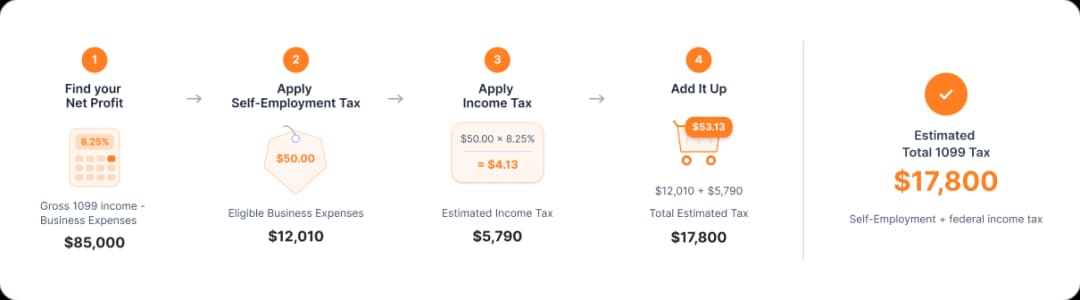
Once you know your net profit, the math follows the same four steps every time: find your profit, apply self-employment tax, apply income tax, then add it up.
- Find your net profit: Gross 1099 income minus business expenses. $95,000 in contracts minus $10,000 in expenses = $85,000 net profit — the figure everything else is built on.
- Apply self-employment tax: You pay 15.3% on 92.35% of net profit. $85,000 × 92.35% = $78,498 → × 15.3% = $12,010.
- Apply income tax: After deductions — half of self-employment tax, the QBI deduction, and the standard deduction — taxable income drops to $50,316. Run through the 2026 brackets: roughly $5,790.
- Add it up: $12,010 self-employment tax + $5,790 income tax = $17,800 total — an effective rate of 20.9%, well under the bracket number that scares people.
A few things can change that number:
For our 1099 tax calculator above, please note:
Tracking your expenses as they happen — not reconstructing a year of receipts in March — is what actually keeps this estimate accurate. That’s the part Global FPO’s bookkeeping team takes off your plate: we track your real profit every month, so this number reflects where your business stands, not a guess built once a year.
If a client never sent you a form, that income is still fully taxable. Global FPO’s tax team can help you track it properly — at no charge.
Using our 1099 tax calculator
Our free calculator estimates your 1099 tax bill from your income and expenses in under two minutes. Here’s how to use it.
STEP 1

Enter your 1099 income and expenses
Add up every 1099-NEC, 1099-K, and any payment where no form showed up at all — that income counts too. Then enter your business expenses separately.
STEP 2

Add your filing status and calculate
Include any W-2 income if you have a day job alongside your freelance work — it changes the math. Hit calculate to get your full breakdown.

Who has to pay tax on 1099 income?
If you’re paid without an employer withholding tax, you generally owe self-employment tax once your net earnings from that work reach $400 for the year — regardless of whether anyone ever sent you a form.
The 1099 reporting threshold itself only decides who has to send paperwork, not what’s taxable:
1099-NEC threshold: Raised to $2,000 for payments made from January 1, 2026 onward.
1099-K threshold: Reverted to $20,000 and 200 transactions after a brief, since-repealed drop to $600.
If a client paid you $1,700 and never sent a form, that $1,700 is still fully taxable income, and you still owe self-employment tax on it. Some states didn’t follow the federal change either, so you may get a state-required form even when federal rules wouldn’t ask for one.
Who this calculator is built for
If you get paid without withholding, this calculator is built for you, including:


It also applies to commission-based professionals and anyone taking pass-through income from a small business
If you have W-2 income alongside your 1099 work, enter it — your wages use up the Social Security wage base first, which changes what you owe on the self-employed side. Most side-hustlers and multi-income earners find this shifts their estimate meaningfully.
1099 tax rate and 2026 tax brackets
Do 1099 workers pay taxes quarterly?
If you expect to owe $1,000 or more for the year, the IRS expects quarterly payments, not one lump sum in April. Payments are due in mid-April, mid-June, mid-September, and mid-January of the following year — yes, the quarters are uneven, and no, that isn’t a typo. Miss one and you’ll owe an underpayment penalty on top of the tax itself.
To stay ahead of it:

Move 25–30% of every payment into a separate account

Recalculate if a quarter comes in stronger or weaker than expected

Know your due dates — they don’t land on the same schedule every quarter.

Use the safe-harbor rule if your income is unpredictable: pay 100% of last year’s tax (110% over $150,000).
The simplest system that works: every time a client pays you, move 25–30% into a separate savings account immediately, and pay your quarterlies out of that account only.

Where Global FPO fits in
If you earn income from working for yourself, you’re generally required to pay self-employment tax once your net earnings cross the IRS threshold, in addition to whatever federal income tax you owe.
That threshold is the trigger that creates the obligation, and it applies whether the work is your main income or a side activity:
Primary self-employment: Freelancing, consulting, or running a business as your main source of income.
Side or occasional income: Gig work, a side business, or freelance projects alongside a full-time W-2 job.
The IRS sets this threshold at $400 in net self-employment earnings for the year – a relatively low bar that catches most people who freelance seriously, not just full-time business owners. Special rules can apply to certain types of income, such as clergy or certain farm income.
Book a free consultation to see how Global FPO keeps your books, deductions, and quarterly payments handled properly — all year, not just in April.


Sales tax calculator FAQ
Answers to common questions, so you know how we make finance simple and stress-free.

The IRS can charge an underpayment penalty - essentially interest on the shortfall - if you pay too little throughout the year, even if you pay the full balance by the April deadline. Catching this early and adjusting your next payment is usually enough to keep it from growing, so review your estimate whenever a quarter looks stronger or weaker than expected.


