 +1 (347) 781-5928
 +61 (485) 921-100
 +44 (7700) 170-900
Profit margin calculator:See exactly how much of every sale you actually keep
Revenue tells you what came in. Profit margin tells you what’s actually yours. Enter your revenue and costs to see your gross margin, net margin, and profit percentage — all in one place.
Total estimated tax owed
Effective tax rate
Net profit
tax
Federal income tax (est.)
Quarterly payment
This free service is for illustrative purposes as-is without warranties. If you intend to rely on these rates, please contact Global FPO Tax expert for free.
What this profit margin calculator actually tells you
Most profit calculators spit out one percentage and call it done. This one breaks your numbers into the pieces that actually explain your business:
- Your gross profit margin: what's left after the direct cost of what you sold
- Your net profit margin: what's left after every expense, the number that actually reflects profitability
- Your profit in dollars and as a percentage: so you can compare across products, months, or years
- How your margin compares to typical benchmarks for businesses like yours
Enter your revenue and costs, and the calculator handles the rest — no signup, no spreadsheet required. It’s built to answer the question that actually matters: not “how much did I sell,” but “how much did I keep.”
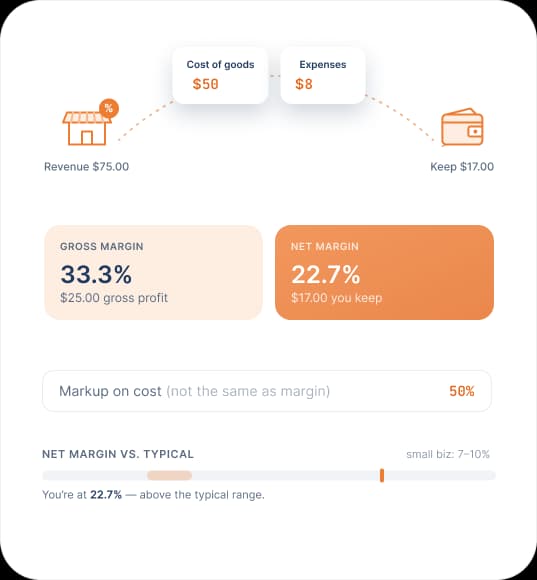
One distinction trips up almost every new business owner: margin and markup are not the same number. A product that costs you $50 and sells for $75 has a 50% markup ($25 on top of a $50 cost) but only a 33% margin ($25 of a $75 sale price). Mixing the two up is one of the most common — and most expensive — pricing mistakes small businesses make.
How to calculate profit margin
Once you know your revenue and costs, the math is four straightforward steps
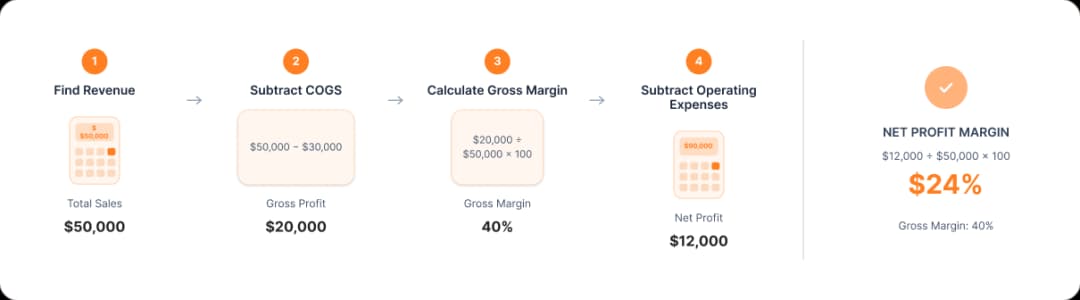
- Find your gross profit:: Revenue minus cost of goods sold (COGS) — the direct cost of making or delivering what you sold. $50,000 in revenue minus $30,000 in COGS = $20,000 gross profit.
- Calculate gross profit margin:: Divide gross profit by revenue, then multiply by 100. $20,000 ÷ $50,000 × 100 = 40% gross margin.
- Subtract operating expenses for net profit:: Rent, payroll, marketing, software, and everything else it costs to run the business. $20,000 gross profit minus $8,000 in operating expenses = $12,000 net profit..
- Calculate net profit margin:: Divide net profit by revenue, then multiply by 100. $12,000 ÷ $50,000 × 100 = 24% net margin.
A few things to keep in mind:
Getting an accurate margin depends on getting COGS and expenses categorized correctly in the first place — miscoded expenses are the single most common reason a business’s “real” margin looks different from what the owner assumed. That’s the kind of bookkeeping accuracy Global FPO builds into monthly financials, not just at tax time.
Mixing up the two is one of the most common pricing mistakes small businesses make. Global FPO can check your numbers for free
Using our profit margin calculator
Our free calculator shows your gross margin, net margin, and profit percentage in under a minute.
STEP 1

Enter your revenue and cost of goods sold
Add your total revenue and the direct cost of what you sold to see your gross profit margin.
STEP 2

Add operating expenses for your net margin
Include rent, payroll, and other overhead to see your true net profit margin, not just gross.

Who needs to track profit margin?
Profit margin matters most at the moments that decide whether a business is actually working.
Setting or adjusting prices:
Without knowing your margin, you’re guessing whether a price covers your costs or quietly loses money.
Comparing products or services:
Revenue alone hides which offerings are actually worth your time — margin shows you.
Raising capital or seeking a loan:
Investors and lenders read margin as a proxy for how well a business is run, not just whether it’s growing.
Even a growing, high-revenue business can be unprofitable if margins are thin enough — tracking margin is how you catch that before it becomes a crisis.
Who this calculator is built for
If any of this sounds like you, this calculator is built for you, including:

If you sell more than one product or service, run the numbers separately for each — a healthy overall margin can easily hide one line item that’s quietly losing money.
Profit margin formulas and industry benchmarks
There’s more than one margin worth tracking, and each answers a different question. The table below shows the core formulas.
Common profit margin mistakes
A few misunderstandings about margin show up constantly — worth clearing up before a pricing decision gets made based on them.
The most common mistakes:

Confusing markup with margin — a 50% markup is only a 33% margin, and pricing off the wrong one leaves money on the table

Only tracking gross margin — a business can look healthy on gross margin and still lose money once overhead is counted.

Judging the business by revenue growth alone — growing sales with shrinking margin means getting bigger and less profitable at the same time.

Judging the business by revenue growth alone — growing sales with shrinking margin means getting bigger and less profitable at the same time.

Where Global FPO fits in
This calculator gives you a real number to work from. What it can’t tell you is why your margin is what it is — whether a supplier cost crept up, whether a product line is dragging the average down, or whether your pricing hasn’t kept pace with your costs.
That’s the work Global FPO does. We’ve spent over 14 years handling bookkeeping and accounting for businesses across the US, UK, Canada, and Australia — the ongoing work that keeps your revenue, COGS, and expenses categorized accurately enough that your margin actually means something. That includes:
- Tracking COGS and expenses accurately enough to trust the margin number
- Breaking down margin by product, service, or client so you can see what’s actually working
- Flagging margin erosion before it becomes a cash-flow problem
- Preparing margin and profitability reporting for investors, lenders, or partners
If you’ve stopped trusting your own numbers, that’s usually the sign it’s time to talk to someone.
Book a free consultation to see how Global FPO keeps your numbers accurate enough to actually run your business on.


Sales tax calculator FAQ
Answers to common questions, so you know how we make finance simple and stress-free.

Markup is profit as a percentage of cost; margin is profit as a percentage of revenue. A $25 profit on a $50 cost is a 50% markup, but that same $25 profit on a $75 sale price is only a 33% margin — same dollars, different denominators, so they're never equal.


