 +1 (347) 781-5928
 +61 (485) 921-100
 +44 (7700) 170-900
Sales Tax Calculator:Estimate Your Rate by State and ZIP Code
Enter a business address to estimate the combined state and local sales tax rate. A full street address is more accurate than a ZIP code, as rates can vary within the same ZIP. Then check your collection requirements and let Global FPO handle the filing.
TOTAL ESTIMATED TAX RATE
State rate
County rate
How to Calculate Sales Tax
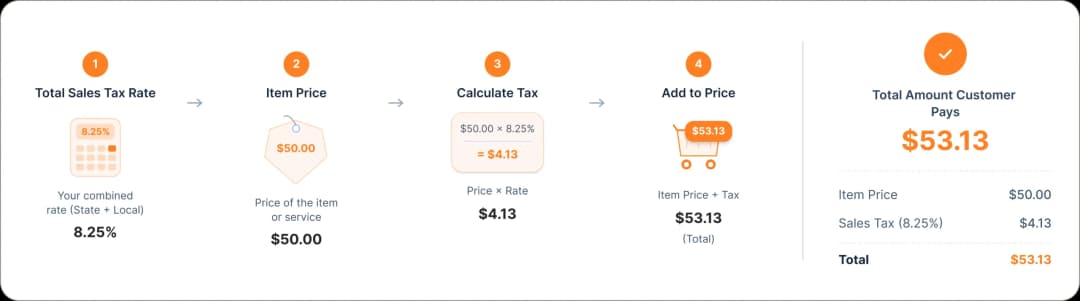
Once you know your combined rate, the math is simple: multiply the price of the taxable item or service by that rate.
- Determine your total sales tax rate.: Use the calculator above, or look up your state in the table further down this page. Say your combined rate comes out to 8.25%.
- Identify: The price of the item or service. For example, $50.
- Calculate the tax: Multiply price by rate: $50 × 8.25% = $4.13.
- Add it to the price: $50 + $4.13 = $53.13 is what the customer pays.
A few things can change that number:
For our sales tax calculator above, please note:
Keeping up with all three of those across every state you sell into is what actually causes filing errors – not the arithmetic. That’s the part Global FPO’s tax support team takes off your plate: we track rate changes and taxability rules for you and file on schedule, so the number above is the last time you have to think about it yourself.
Get help and guidance when you need it from real Intuit Experts.
Using our sales tax calculator
Our free sales tax calculator makes it easy to calculate the sales tax rates in your state. Follow these simple steps to get started.
STEP 1

Enter your business address
Sales tax can vary within the same ZIP code, so enter a complete street address, city, and state for the most accurate estimate.
STEP 2

Click the “Get rate estimate” button
Get an estimated combined state and local sales tax rate for the address. Actual rates may vary by product, service, customer type, and transaction.
Who has to collect Sales Tax?
If your business sells taxable goods or services, you generally need to register for a sales tax permit in any state where you have nexus, then collect and remit tax on taxable sales there.
Nexus is the connection that creates that obligation, and it comes in two forms:
Physical nexus: an office, warehouse, employee, or inventory located in the state.
Economic nexus: selling enough into a state to cross its threshold, even with no physical presence there at all.
Since the 2018 South Dakota v. Wayfair decision, most states have economic nexus thresholds based on sales, transactions, or both. Thresholds vary widely by state-for example, some use $100,000 in sales, while others use higher thresholds or transaction counts. These rules can also change over time.
What items do you Collect Sales Tax for?
Sales tax generally applies to tangible goods sold for personal or business use, including:


Beyond standard goods, some states tax luxury items, RVs, specified services, and digital products like software and streaming.
Groceries are typically exempt or taxed at a reduced rate, while wholesale purchases and raw materials bought for resale or production are generally exempt with a valid resale certificate. However, exemptions vary by state, so always confirm whether an item is tax-free before assuming.
Sales Tax Rate by State
Sales tax rates vary widely by state, and five states charge no statewide sales tax at all: Alaska, Delaware, Montana, New Hampshire, and Oregon (shaded below). The table shows each state's base rate and the average combined rate once typical local taxes are added. Treat this as a reference point - the calculator at the top of this page gives you a rate for one specific address, which is what to rely on for an actual transaction.
| State | State Tax Rate | Average Local Rate | Average Combined Rate |
|---|---|---|---|
| Alabama | 4.00% | 5.46% | 9.46% |
| Alaska | 0.00% | 1.82% | 1.82% |
| Arizona | 5.60% | 2.94% | 8.54% |
| Arkansas | 6.50% | 2.98% | 9.48% |
| California | 7.25% | 1.78% | 9.03% |
| Colorado | 2.90% | 4.99% | 7.89% |
| Connecticut | 6.35% | 0.00% | 6.35% |
| Delaware | 0.00% | 0.00% | 0.00% |
| District of Columbia | 6.00% | 0.00% | 6.00% |
| Florida | 6.00% | 0.98% | 6.98% |
| Georgia | 4.00% | 3.56% | 7.56% |
| Hawaii | 4.00% | 0.50% | 4.50% |
| Idaho | 6.00% | 0.03% | 6.03% |
| Illinois | 6.25% | 2.73% | 8.98% |
| Indiana | 7.00% | 0.00% | 7.00% |
| Iowa | 6.00% | 0.94% | 6.94% |
| Kansas | 6.50% | 2.21% | 8.71% |
| Kentucky | 6.00% | 0.00% | 6.00% |
| Louisiana | 5.00% | 5.13% | 10.13% |
| Maine | 5.50% | 0.00% | 5.50% |
| Maryland | 6.00% | 0.00% | 6.00% |
| Massachusetts | 6.25% | 0.00% | 6.25% |
| Michigan | 6.00% | 0.00% | 6.00% |
| Minnesota | 6.88% | 1.26% | 8.14% |
| Mississippi | 7.00% | 0.06% | 7.06% |
| Missouri | 4.23% | 4.22% | 8.44% |
| Montana | 0.00% | 0.00% | 0.00% |
| Nebraska | 5.50% | 1.48% | 6.98% |
| Nevada | 6.85% | 1.39% | 8.24% |
| New Hampshire | 0.00% | 0.00% | 0.00% |
| New Jersey | 6.63% | 0.00% | 6.60% |
| New Mexico | 4.88% | 2.80% | 7.68% |
| New York | 4.00% | 4.54% | 8.54% |
| North Carolina | 4.75% | 2.35% | 7.10% |
| North Dakota | 5.00% | 2.09% | 7.09% |
| Ohio | 5.75% | 1.54% | 7.29% |
| Oklahoma | 4.50% | 4.56% | 9.06% |
| Oregon | 0.00% | 0.00% | 0.00% |
| Pennsylvania | 6.00% | 0.34% | 6.34% |
| Rhode Island | 7.00% | 0.00% | 7.00% |
| South Carolina | 6.00% | 1.49% | 7.49% |
| South Dakota | 4.20% | 1.91% | 6.11% |
| Tennessee | 7.00% | 2.61% | 9.61% |
| Texas | 6.25% | 1.95% | 8.20% |
| Utah | 6.10% | 1.32% | 7.42% |
| Vermont | 6.00% | 0.43% | 6.43% |
| Virginia | 5.30% | 0.47% | 5.77% |
| Washington | 6.50% | 3.07% | 9.57% |
| West Virginia | 6.00% | 0.60% | 6.60% |
| Wisconsin | 5.00% | 0.72% | 5.72% |
| Wyoming | 4.00% | 1.39% | 5.39% |
How often Should you File Sales Tax Returns?
How often you file depends on the state and how much tax you collect. Most states default to monthly filing and step down to quarterly or annual filing once your collected tax volume drops below a state-set amount. Filing and payment are usually due on or after the 20th of the month following the reporting period — tax collected in April, for instance, is typically due around May 20th.

Track rate and rule changes in every state where you have nexus.

Keep detailed, date-stamped records of every taxable transaction.

Know your filing frequency in each state and set reminders well before the due date.

Use a system software, a bookkeeper, or an outsourced tax team that actually calculates and tracks this, rather than relying on memory.
To stay ahead of it:
Where Global FPO Fits in
A calculator can tell you today’s rate. It can’t tell you that your nexus footprint changed last quarter, that a state you sell into just adjusted its threshold, or that a filing is due in nine days. That’s the part a tool alone doesn’t solve — and it’s the part that actually causes penalties and back-tax bills.
Global FPO’s tax support team folds sales tax tracking, filing, and remittance into the bookkeeping and accounting work we already do for you, so it’s handled by people who are already looking at your books every month — not a separate tool you have to remember to check. That includes:
- Monitoring nexus across every state you sell into as your revenue grows
- Registering for a sales tax permit where you’ve become newly obligated
- Calculating, filing, and remitting returns on the correct schedule for each state
- Reconciling sales tax against your books so nothing gets missed at year-end
If you’re already working with Global FPO for bookkeeping or accounting, sales tax support plugs directly into that relationship. If you’re not yet, it’s one of the more straightforward places to start.
Book a free consultation to see how our tax support team can track nexus, file returns, and keep you compliant in every state you sell into.


Sales tax calculator FAQ
Answers to common questions, so you know how we make finance simple and stress-free.

Refund the excess to the customer as soon as you catch it, and keep a record of the correction. Most states don't want a business holding on to over-collected tax some require you to refund it or remit the excess anyway, so document the correction rather than quietly adjusting your books.


