 +1 (347) 781-5928
 +61 (485) 921-100
 +44 (7700) 170-900
Estimate Your Self Employment Taxes in Minutes
Estimate your 2026 self-employment tax and see how it stacks against federal income tax. Get rates, deadlines, and how Global FPO’s tax team can help you plan ahead.
Total estimated tax owed
Effective tax rate
Net profit
Self-employment tax
Federal income tax (est.)
Quarterly payment
This free service is for illustrative purposes as-is without warranties. If you intend to rely on these rates, please contact Global FPO Tax expert for free.
What is self-employment tax?
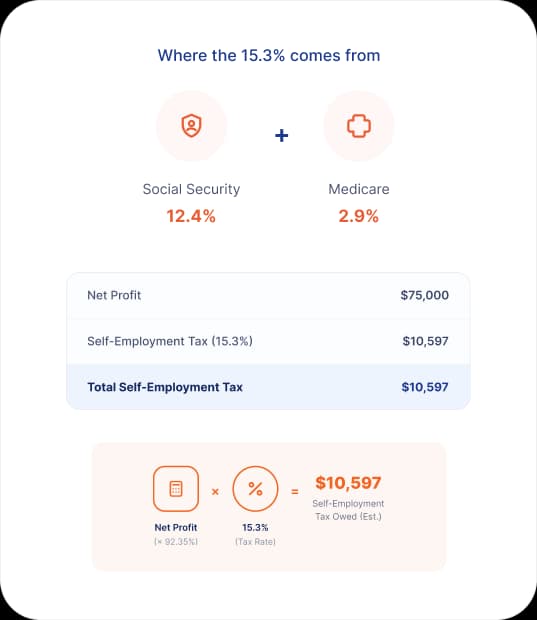
Self-employment tax is the Social Security and Medicare tax that self-employed workers pay on their own behalf, since there’s no employer to withhold and match it for them. Unlike a traditional paycheck, where an employer covers half automatically, someone who works for themselves is responsible for both the employee and employer portions – which is where the 15.3% rate comes from.
Because the rate applies to net earnings rather than total revenue, the amount you actually owe depends entirely on your profit, not your income. Business expenses, filing status, and other income can all shift what you end up owing:
Self-Employment Tax = Net Profit × 92.35% × 15.3%
- For example, the tax owed on the same revenue can look very different depending on the details: $90,000 in revenue, $15,000 in expenses: $75,000 net profit → roughly $10,597 in self-employment tax.
- The same $90,000 with no tracked expenses: tax is calculated on the full amount, not the true profit.
- Add a W-2 job into the mix: your wages count against the same Social Security wage cap, which can lower what's owed.
That’s why net profit – not gross revenue – is what actually drives your self-employment tax bill.
How to calculate self-employment tax
Once you know your net profit, the math follows a fixed formula: apply 92.35%, then apply the 15.3% self-employment tax rate.
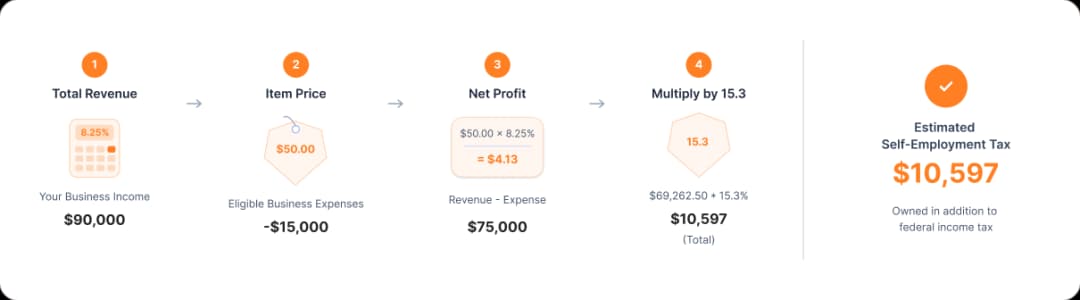
- Calculate your net profit: Subtract eligible business expenses from your self-employment income. Say your business earned $90,000 and had $15,000 in expenses, leaving a $75,000 net profit.
- Apply 92.35%: Multiply your net profit by 92.35%: $75,000 × 92.35% = $69,262.50.
- Apply the rate: Multiply that figure by 15.3%: $69,262.50 × 15.3% ≈ $10,597.
- That's your estimate: $10,597 is your estimated self-employment tax, owed in addition to federal income tax.
A few things can change that number:
For our self-employment tax calculator above, please note:
Keeping your expense records current across the year is what actually keeps this estimate accurate – not the arithmetic. That’s the part Global FPO’s bookkeeping team takes off your plate: we track your real profit every month and help you set aside the right amount, so this number reflects where your business actually stands, not a guess from January.
Global FPO's tax team can build your estimated payments from your actual monthly numbers, across every income stream - at no charge.
Using our self-employment tax calculator
Our free calculator estimates your self-employment tax from your income and expenses in a few seconds. Here's how to use it.
STEP 1

Enter your income and expenses
Enter your total self-employment income and your eligible business expenses separately, so the calculator can work from your actual net profit, not your gross revenue.
STEP 2

Click “Calculate My Self-Employment Tax”
Get an estimated self-employment tax figure based on your net profit. Actual amounts may vary by filing status, other income, deductions, and credits.
Who needs to pay self-employment tax?
If you earn income from working for yourself, you’re generally required to pay self-employment tax once your net earnings cross the IRS threshold, in addition to whatever federal income tax you owe.
That threshold is the trigger that creates the obligation, and it applies whether the work is your main income or a side activity:
Primary self-employment: Freelancing, consulting, or running a business as your main source of income
Side or occasional income: Gig work, a side business, or freelance projects alongside a full-time W-2 job.
The IRS sets this threshold at $400 in net self-employment earnings for the year – a relatively low bar that catches most people who freelance seriously, not just full-time business owners. Special rules can apply to certain types of income, such as clergy or certain farm income.
Who this calculator is for
Self-employment tax generally applies to anyone earning money by working for themselves, including:


Beyond typical freelance work, it can also apply to real estate professionals, multi-income earners, and small business owners.
Rental income and investment income – interest, dividends, capital gains – are typically not subject to self-employment tax, since they generally aren’t treated as earnings from a trade or business. However, exceptions exist for real estate professionals and certain active rental businesses, so always confirm before assuming either way.
Self-employment tax rate and 2026 tax brackets
Do self-employed people pay quarterly taxes?
Whether you pay quarterly depends on how much you expect to owe. If your tax liability is high enough, the IRS expects four estimated payments across the year rather than one lump sum at filing time. Payments are generally due in mid-April, mid-June, mid-September, and mid-January of the following year, covering the income earned in each period – and if a due date falls on a weekend or holiday, it shifts to the next business day.
To stay ahead of it:

Set aside a percentage of every payment as it comes in

Keep detailed, date-stamped records of income and expenses

Know your quarterly due dates and set reminders.

Use tax software or an outsourced tax team to calculate your payments
When estimating and paying your self-employment taxes, ensure you’re setting aside enough each month and adjusting your estimate if a strong quarter changes what you owe.
Where Global FPO fits in
A calculator can tell you today’s number. It can’t tell you that your best quarter just pushed you into a higher bracket, that a client you 1099’d should have been on payroll, or that the estimate you built in January stopped matching reality by June. That’s the part a tool alone doesn’t solve – and it’s the part that actually causes underpayment penalties.
Global FPO’s bookkeeping and tax support team works from your actual, current numbers instead of a once-a-year reconstruction, so it’s handled by people who are already looking at your books every month – not a separate estimate you have to remember to update. That includes:
Tracking your net profit as it changes throughout the year
Calculating and reminding you of each quarterly payment
Finding deductible expenses as they happen, not at filing time
Reconciling your estimated payments against your books at year-end
If you’re already working with Global FPO for bookkeeping or accounting, tax support plugs directly into that relationship. If you’re not yet, it’s one of the more straightforward places to start.
Book a free consultation to see how our tax support team can track your profit, calculate your payments, and keep you ahead of every deadline


Sales tax calculator FAQ
Answers to common questions, so you know how we make finance simple and stress-free.

The IRS can charge an underpayment penalty - essentially interest on the shortfall - if you pay too little throughout the year, even if you pay the full balance by the April deadline. Catching this early and adjusting your next payment is usually enough to keep it from growing, so review your estimate whenever a quarter looks stronger or weaker than expected.


