 +1 (347) 781-5928
 +61 (485) 921-100
 +44 (7700) 170-900
Tax bracket calculator:See your real federal income tax rate for 2025 and 2026
You know your income. You don’t know exactly what it costs you. Enter your income and filing status to see your tax bracket, your effective tax rate, and what you actually owe — for the current 2026 tax year or a 2025 return.
TOTAL ESTIMATED TAX RATE
No signup. No credit card. No email wall. This estimate is for planning purposes only — for a filing-ready number, talk to Global FPO's tax team for free.
What this tax bracket calculator actually tells you
Most bracket calculators show you a chart and let you do the guessing. This one turns your income into four numbers that actually matter:
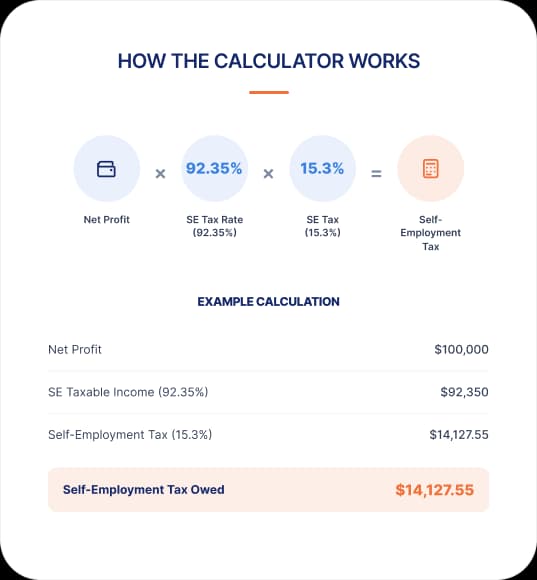
Self-Employment Tax = Net Profit × 92.35% × 15.3%
- Your marginal tax bracket: useful before a raise, bonus, or side income pushes you into it
- Your effective tax rate: what you actually pay as a share of your income, always lower than your bracket
- Your total federal tax bill: in dollars, not just a percentage
Enter your income and filing status, and the calculator runs both the 2025 and 2026 brackets — no signup, no email wall. It’s built to answer the question people actually have, which isn’t “what bracket am I in,” it’s “how much of this is really mine.”
Here’s the part that trips almost everyone up: being in the 22% bracket doesn’t mean the IRS takes 22% of your income. Only the slice of income that falls inside that bracket is taxed at 22% — every dollar below it is still taxed at the lower rates first. That gap is why your effective rate is almost always several points below your bracket.
How tax brackets actually work
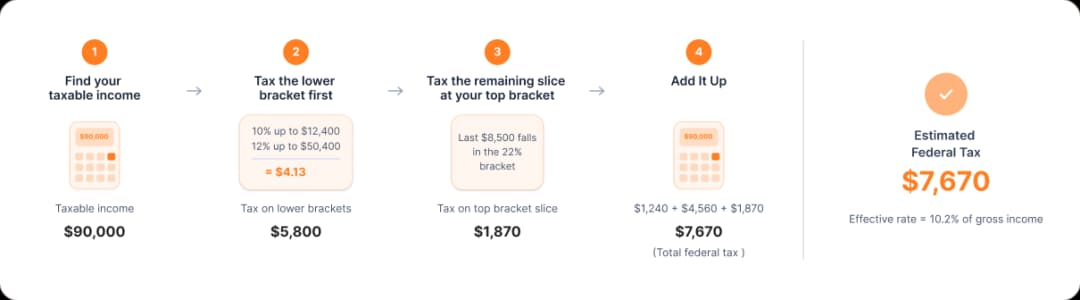
Once you know your taxable income, the math follows the same steps every time: find your taxable income, tax each slice at its own rate, add it up, then check your effective rate.
- Find your taxable income: Subtract eligible business expenses from your self-employment income. Say your business earned $90,000 and had $15,000 in expenses, leaving a $75,000 net profit.
- Tax the lower bracket first: The first $12,400 is taxed at 10% ($1,240). The next $38,000, up to $50,400, is taxed at 12% ($4,560).
- Tax the remaining slice at your top bracket: The last $8,500, up to $58,900, falls in the 22% bracket — that's $1,870. 22% is this filer's marginal bracket, but it only ever applies to that last slice.
- Add It Up: $1,240 + $4,560 + $1,870 = $7,670 total federal tax — an effective rate of about 10.2% of gross income, well under the 22% the bracket number implies.
A few things can change that number:
Knowing your real bracket — not guessing from your salary — is what makes decisions like Roth conversions, bonus timing, and year-end retirement contributions actually pay off. That’s the kind of planning Global FPO’s tax team does with clients year-round, not just in April.
Moving into a new bracket only affects the income inside it. Global FPO's tax team can show you exactly what a raise, bonus, or side income actually costs — at no charge
Using our tax bracket calculator
Our free calculator shows your exact tax bracket, effective rate, and federal tax bill in under a minute. Here's how to use it.
STEP 1

Enter your income and filing status
Add your gross annual income and select single, married filing jointly, head of household, or married filing separately.
STEP 2

Choose a tax year and calculate
Pick 2025 or 2026 — the brackets and standard deduction differ slightly between the two — then hit calculate to see your full breakdown.

Who needs to know their tax bracket?
Your tax bracket matters most at the moments that change it — a raise, a bonus,
a new job, a side hustle, or a big financial decision.
Getting a raise or bonus:
Knowing Which Bracket The Extra Income Lands In Tells You What To Actually
Expect To Take Home, Not Just The Round Number On The Offer Letter.
Earning from more than one source:
W-2 Wages Plus Freelance Or 1099 Income Stack Into One Combined Bracket, And
It’s Easy To Underestimate What The Total Actually Owes.
Planning around retirement:
Roth Conversions, IRA Withdrawals, And Required Minimum Distributions Are All
Bracket-Sensitive — The Wrong Year Can Cost Thousands.
Married couples deciding how to file also feel this directly; filing jointly
versus separately can land you in meaningfully different brackets depending on
how income splits between spouses.
Who this calculator is built for
If any of this sounds like you, this calculator is built for you, including:

If your income comes from more than one source, add it all together before you calculate — brackets apply to your combined taxable income, not to each income stream separately.
2025 and 2026 federal income tax brackets
Single filers
Common tax bracket mistakes

Thinking a raise pushes your entire income into the new bracket — only the amount inside that bracket is taxed at the higher rate.

Confusing your bracket with your effective rate — they're rarely the same number, and the gap is often 8 to 10 percentage points

Forgetting deductions apply before brackets — your bracket is based on taxable income, not gross income

Not rechecking your bracket after a life change — marriage, a new job, or new side income can shift it before you notice.
A few misunderstandings about brackets show up constantly — worth clearing up before a decision gets made based on them.
The most common mistakes:

Where Global FPO fits in
This calculator tells you exactly where you stand right now. What it can’t tell you is whether there’s a smarter way to get there — whether adjusting your withholding, timing a bonus, or restructuring how you’re paid could keep more of your income in a lower bracket.
That’s the planning work Global FPO does. We’ve spent over 14 years handling accounting, bookkeeping, and tax planning for individuals and businesses across the US, UK, Canada, and Australia — building the kind of ongoing relationship where your bracket, deductions, and filing status get reviewed before decisions are made, not after. That includes:
- Reviewing your withholding so you’re not overpaying all year or facing a surprise bill in April
- Timing bonuses, Roth conversions, and large deductions around bracket thresholds
- Coordinating W-2 income with 1099 or business income so your combined bracket doesn’t catch you off guard
- Planning ahead of life changes — marriage, a new job, a growing side business — before they change your tax picture
If your income has gotten complicated enough that bracket math alone doesn’t answer your real question, that’s usually the sign it’s time to talk to someone.
Book a free consultation to see how Global FPO helps you plan around it — all year, not just once a year at tax time.


Tax bracket calculator FAQ
Answers to common questions, so you know how we make finance simple and stress-free.
Your tax bracket is the rate applied to your top slice of income. Your tax rate — more precisely, your effective tax rate — is your total tax divided by your total income, and it's almost always several points lower than your bracket, because the income below that top slice is taxed at lower rates first.


