
Article Summary:
- Form 8594 is an IRS form used by buyers and sellers to report the allocation of a business acquisition purchase price under IRC Section 1060.
- Both parties must file Form 8594 with their federal income tax returns and report the same purchase price allocation.
- The purchase price must be allocated using the residual method across seven IRS-defined asset classes.
- Understanding the seven asset classes helps ensure accurate asset valuation, tax basis calculations, and future depreciation or amortization.
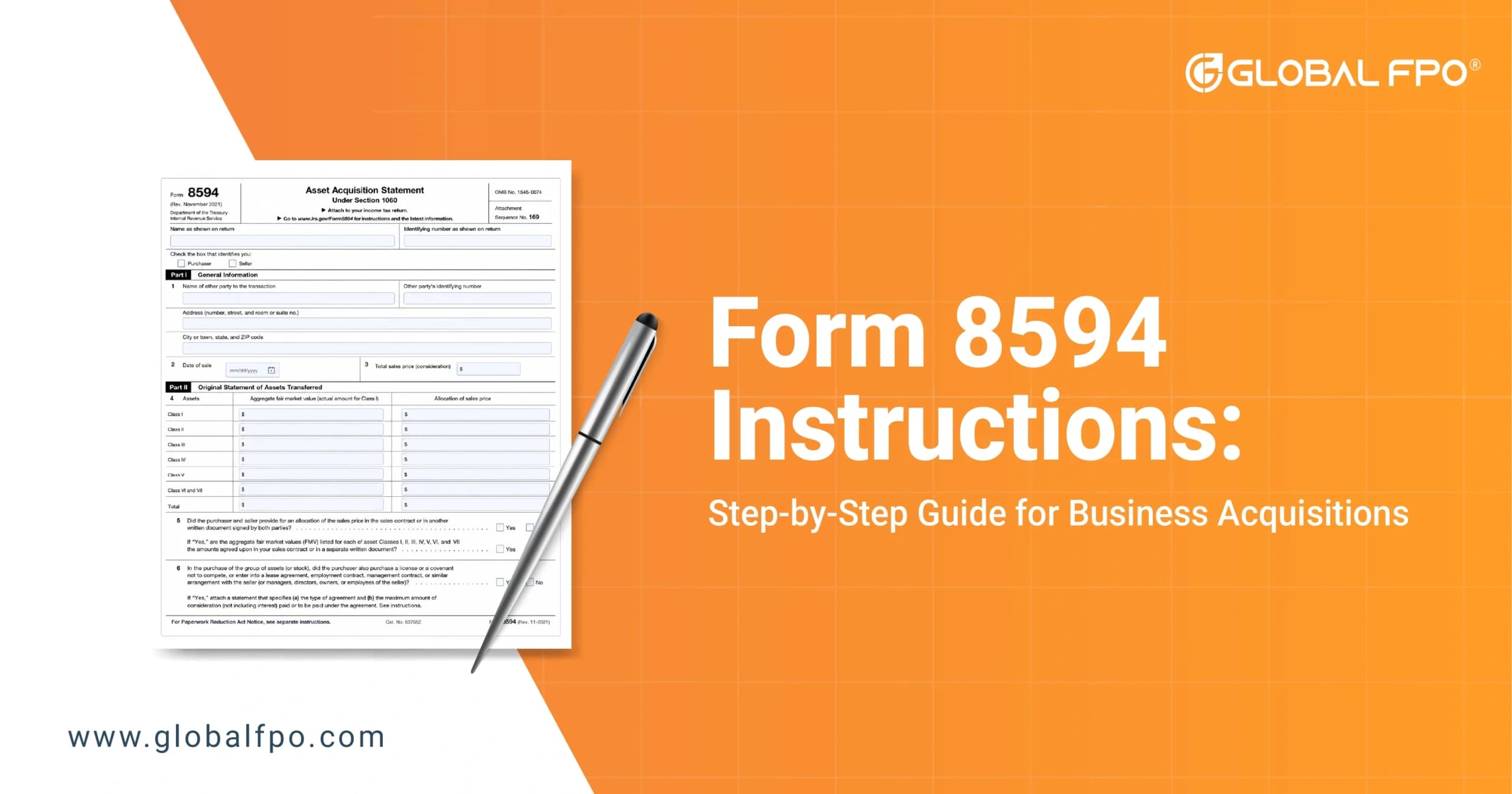
- Form 8594 includes three parts covering transaction details, asset allocation, and post-acquisition purchase price adjustments.
- Accurate documentation, including purchase agreements, valuation reports, and financial records, supports proper Form 8594 reporting.
- Consistent reporting between the buyer and seller helps reduce IRS inquiries and compliance risks.
- Following the official Form 8594 instructions ensures accurate filing and supports proper tax reporting for business acquisitions.
Business acquisitions involve more than negotiating a purchase price. Both buyers and sellers must also report how that purchase price is allocated among the acquired assets for federal tax purposes. This reporting requirement is fulfilled through Form 8594. Through our Form 8594 instructions guide you will be able to understand its importance and requirement.
The IRS uses IRS Form 8594, Asset Acquisition Statement Under Section 1060, to ensure both parties report the transaction consistently. The form requires buyers and sellers to allocate the purchase price among specific asset categories and attach the completed form to their tax returns for the year of acquisition.
Understanding the allocation rules and completing the form correctly can help prevent reporting discrepancies and potential IRS scrutiny. This guide explains the purpose of Form 8594, the seven asset classes used under Section 1060, and the step-by-step process for completing the form.
Quick Answer:
Form 8594 is an IRS form used by buyers and sellers in an applicable asset acquisition to report how the purchase price is allocated among acquired business assets under IRC Section 1060. Both parties must file the form with their federal income tax returns and report the same asset allocation. Properly completing Form 8594 helps establish the buyer’s tax basis, supports accurate depreciation and amortization calculations, and reduces the risk of IRS reporting discrepancies.
What Is Form 8594?
Form 8594 is an IRS reporting document used when a group of business assets is acquired and the buyer’s basis in those assets is determined solely by the purchase price.
The form is required under Internal Revenue Code Section 1060 for applicable asset acquisitions.
Additionally, both the buyer and seller must complete IRS Form 8594 and attach it to their federal income tax return and attach it to their federal income tax returns for the tax year in which the acquisition occurs.
The primary purpose of the form is to:
- Report the total purchase price
- Allocate consideration among acquired assets
- Ensure both parties report the transaction consistently
- Establish tax basis for acquired assets
- Determine future depreciation and amortization calculations
Because the IRS compares both filings, accurate and consistent reporting is essential.
When Is Form 8594 Required?
Not every business transaction requires Form 8594.
The form generally applies when:
- A trade or business is acquired
- Assets are purchased rather than stock
- The buyer’s basis is determined by the purchase price
- Multiple business assets are transferred as part of a single transaction
Common examples include:
- Asset purchase agreements
- Business acquisitions
- Purchase of operating divisions
- Acquisition of customer lists and business assets
The filing requirement applies to both parties involved in the transaction.
Also Check: What Is Tax Form 1120 and How to File It
Understanding the Seven Asset Classes Under Section 1060
Before reviewing the Form 8594 instructions, it is important to understand how the IRS categorizes assets.
Under Section 1060, the purchase price is allocated using the residual method across seven asset classes. Assets are assigned in a specific order, with any remaining value ultimately allocated to goodwill.
Financial Assets
The first three asset classes include financial assets that generally have readily identifiable values and are allocated first under the IRS residual method.
Class I: Cash and Deposit Accounts
Class I includes:
- Cash
- Checking accounts
- Savings accounts
- General deposit accounts
Because cash already has a readily determinable value, it is allocated first.
Class II: Actively Traded Personal Property
This category includes:
- Certificates of deposit
- U.S. government securities
- Publicly traded securities
- Other actively traded financial instruments
These assets typically have easily identifiable market values.
Class III generally includes:
- Trade receivables
- Credit card receivables
- Mortgage receivables
- Other outstanding payment obligations
These assets represent money owed to the acquired business.
Business Assets
These asset classes include inventory and tangible business property used in day-to-day operations.
Class IV: Inventory
Inventory includes:
- Finished goods
- Raw materials
- Merchandise held for sale
- Stock-in-trade
Inventory often represents a significant portion of the purchase price in retail, manufacturing, and distribution businesses.
Class V: Other Tangible Assets
Class V covers assets that do not fit within the other categories.
Examples include:
- Machinery
- Equipment
- Furniture
- Fixtures
- Vehicles
- Buildings
- Land
Many operating assets fall into this category.
Intangible Assets
The final asset classes include identifiable intangible assets and goodwill, which typically receive the remaining purchase price after other assets have been allocated.
Class VI: Section 197 Intangibles
Class VI includes certain intangible assets other than goodwill.
Examples include:
- Patents
- Trademarks
- Licenses
- Franchises
- Covenants not to compete
These assets often have independent economic value separate from goodwill.
Class VII: Goodwill and Going-Concern Value
Class VII receives any remaining purchase price after allocations to Classes I through VI.
This category includes:
- Goodwill
- Brand reputation
- Customer relationships
- Going-concern value
In many acquisitions, goodwill represents a substantial portion of the overall purchase price.
Also Read: IRS Form 8990 Instructions Explained
Why Is Asset Allocation Important?
Asset allocation directly affects the tax consequences for both parties.
For buyers, allocations determine:
- Depreciation deductions
- Amortization deductions
- Future tax basis calculations
For sellers, allocations may affect:
- Ordinary income treatment
- Capital gain treatment
- Overall tax liability
Because different asset categories receive different tax treatment, allocation negotiations often become an important part of acquisition discussions.
The values reported on the 8594 Form can influence tax outcomes for years after the transaction closes.
Part I
Part I captures general information about the transaction and the parties involved.
Enter Taxpayer Information
Provide:
- Your name
- Address
- Taxpayer Identification Number (TIN)
You must also provide information for the other party involved in the transaction.
Enter Transaction Details
Part I also requires:
- Date of sale
- Total aggregate consideration paid
- Basic transaction information
The aggregate consideration should reflect the total purchase price allocated across all asset classes.
Accurate reporting in this section establishes the foundation for the remainder of IRS Form 8594.
Part II
Part II contains the most important information on the form.
This section reports the allocation of the purchase price among the seven asset classes.
Report Fair Market Values
For each asset class, enter:
- Aggregate Fair Market Value (FMV)
- Allocated purchase price
The allocation should follow the residual method required under Section 1060.
The IRS expects the reported allocations to reflect reasonable fair market values supported by transaction documentation and valuation analyses.
Disclose Allocation Agreements
Part II also asks whether:
- Buyer and seller agreed to the allocation in writing
- The allocation appears in the purchase agreement
Written agreements often help reduce future disputes regarding allocation methods.
Report Related Agreements
The form also requires disclosure of collateral agreements associated with the transaction.
Examples include:
- Employment agreements
- Consulting contracts
- Covenants not to compete
- Lease agreements
- License agreements
These arrangements may affect how consideration is allocated among asset classes.
Part III
Part III is not typically completed during the initial filing.
This section serves as a supplemental reporting mechanism for future changes.
When Should Part III Be Used?
Part III is completed only if:
- Purchase price adjustments occur
- Earn-out provisions are resolved
- Additional consideration is paid
- Asset allocations change after the original filing
In those situations, both parties must file an updated statement reflecting the revised allocation. For most initial filings, this section remains blank.
What are the Key Filing Rules for Form 8594?
Several IRS rules govern how Form 8594 must be reported.
Understanding these requirements helps ensure compliance.
1. Both Parties Must File
The buyer and seller must each file IRS Form 8594. Failure by one party to file does not eliminate the obligation for the other party.
2. Consistent Reporting Is Required
As a result, the IRS compares both submissions to verify that both parties reported the same asset allocation. The allocation reported by the buyer should match the allocation reported by the seller. Differences between filings can trigger IRS inquiries and additional review.
3. The Allocation Is Generally Binding
Once the parties agree on an allocation in the purchase agreement or on the 8594 Form, that allocation is generally binding for tax purposes.
The IRS typically does not permit either party to adopt a different allocation later unless specific circumstances justify the change.
4. Attach the Form to Your Tax Return
The completed form must be attached to the appropriate federal income tax return.
Examples include:
The attachment requirement applies for the tax year in which the acquisition occurs.
Documents to Gather Before Completing Form 8594
Preparing documentation in advance can simplify the filing process.
Important records include:
- Asset purchase agreement
- Business valuation reports
- Closing statements
- Fixed asset schedules
- Inventory reports
- Accounts receivable schedules
- Goodwill calculations
- Supporting allocation analyses
These documents help substantiate the reported values and allocations.
Complete Form 8594 Carefully to Ensure Accurate Asset Allocation
Proper completion of Form 8594 is an important part of any business acquisition. The form establishes how the purchase price is allocated among acquired assets, affects future tax treatment for both parties, and provides the IRS with a consistent record of the transaction.
Following the official Form 8594 instructions, understanding the seven asset classes, and ensuring both parties report identical allocations can help reduce compliance risks and support accurate tax reporting. Whether you are buying or selling a business, careful preparation of IRS Form 8594 is essential for a successful transaction.
Need Help with Form 8594 or Business Acquisition Accounting?
From purchase price allocation to financial reporting and bookkeeping, Global FPO helps businesses and CPA firms simplify complex acquisition accounting and stay IRS compliant.
Talk to Our Experts →
FAQs
1. What is Form 8594 used for?
Ans. Form 8594 is used by buyers and sellers to report the sale of business assets and allocate the purchase price among asset classes under IRC Section 1060.
2. Who must file IRS Form 8594?
Ans. Both the buyer and seller involved in an applicable asset acquisition must file IRS Form 8594 with their federal income tax returns.
3. What is the residual method?
Ans. The residual method allocates the purchase price among seven asset classes in a prescribed order, with any remaining value assigned to goodwill.
4. What assets are included in Class V?
Ans. Class V generally includes machinery, equipment, furniture, vehicles, buildings, and other tangible assets not included in the earlier classes.
5. What is Class VII under Form 8594?
Ans. Class VII includes goodwill and going-concern value, which typically represent the remaining purchase price after other asset classes are allocated.
6. Can Form 8594 be amended?
Ans. Yes. If purchase price adjustments or allocation changes occur after the initial filing, Part III may be used to report supplemental information.
7. What happens if buyer and seller report different allocations?
Ans. The IRS cross-checks both filings. Inconsistent reporting may trigger inquiries, audits, or requests for additional documentation.
8. How can Global FPO assist with Form 8594 reporting?
Ans. Global FPO can support businesses by organizing acquisition records, reviewing financial information, and assisting with transaction-related accounting processes that support accurate reporting.
9. Can Global FPO help with purchase price allocation analysis?
Ans. Yes. Global FPO can assist businesses with financial reporting support, asset classification reviews, and documentation preparation related to acquisition accounting.
10. What other transaction support services does Global FPO provide?
Ans. In addition to assistance related to Form 8594, Global FPO offers outsourced accounting, bookkeeping, financial reporting, tax support, due diligence assistance, and back-office finance solutions for growing businesses.