Choosing the right business structure affects how you pay taxes, raise capital, and scale your operations. The S Corp vs C Corp decision is one of the most important early choices for any business owner.
Both S Corporations and C Corporations provide limited liability protection, which means your personal assets are generally protected from business debts. However, the similarities stop there. The real differences come from taxation, ownership rules, and long-term flexibility.
If you are evaluating the C Corp vs S Corp structure, this guide breaks it down in a clear, practical way so you can make the right call.
What Is the Difference Between S Corp and C Corp?
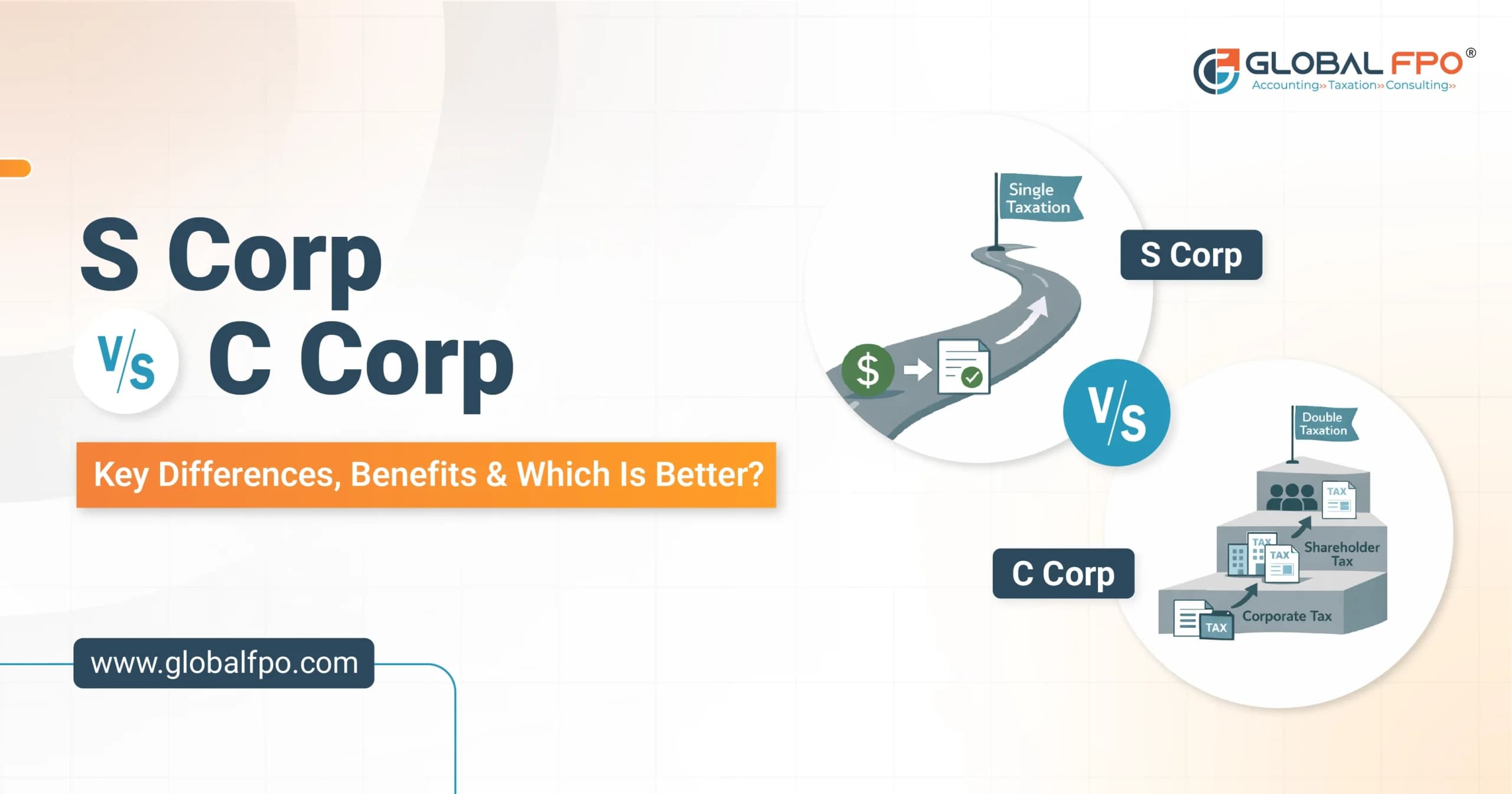
The difference between S Corp and C Corp comes down to taxation and ownership structure. An S Corporation is a tax election that allows income to pass through directly to shareholders. A C Corporation is taxed as a separate legal entity.
Here is the core distinction:
- S Corps are taxed once at the individual level
- C Corps are taxed at both corporate and shareholder levels
This single difference shapes how profits are handled and how businesses grow. That is why the S vs C Corp decision goes beyond compliance and directly impacts your financial strategy.
How Does Taxation Work in S Corp vs C Corp?
Taxation is the most important factor in the C Corporation vs S Corporation comparison.
S Corporations follow pass-through taxation. The business itself does not pay federal income tax. Instead, profits and losses pass through to shareholders, who report them on personal tax returns. This avoids double taxation and allows losses to offset other income.
C Corporations are taxed separately. The business pays corporate tax on profits, and shareholders pay taxes again on dividends. This creates the double taxation commonly discussed in the C Corp vs S Corp debate.
Here is a quick comparison:
| Tax Aspect |
S Corporation |
C Corporation |
| Federal Tax |
No corporate tax |
Corporate tax applies |
| Shareholder Tax |
Personal income tax |
Tax on dividends |
| Double Taxation |
No |
Yes |
| Loss Utilization |
Can offset personal income |
Stays within company |
Another important point in the S Corp vs C Corp discussion is retained earnings. C Corporations can retain profits within the business without distributing them, which can support reinvestment and growth.
What Are the Ownership Restrictions in S Corp vs C Corp?
Ownership rules play a major role in deciding between a C-corp and an S-corp. S Corporations have strict limitations:
- Maximum of 100 shareholders
- Only U.S. citizens or residents are allowed
- Limited types of eligible shareholders
These restrictions make S Corps suitable for smaller, closely held businesses.
C Corporations offer far more flexibility:
- Unlimited number of shareholders
- Foreign investors allowed
- Businesses and institutions can invest
In many C Corp vs S Corp scenarios, this flexibility becomes critical as businesses grow and seek funding.
Can S Corp and C Corp Structures Support Different Types of Stock?
Stock structure is often overlooked but plays a key role in the S Corp vs C Corp decision.
S Corporations are limited to one class of stock. This means all shareholders have equal rights to profits and distributions. While this keeps things simple, it limits flexibility in structuring ownership.
C Corporations can issue multiple classes of stock, including common and preferred shares. This allows businesses to offer different rights to different investors. Here is how the C Corporation vs S Corporation comparison looks in this area:
| Feature |
S Corporation |
C Corporation |
| Stock Classes |
One |
Multiple |
| Investor Flexibility |
Limited |
High |
| Preferred Shares |
Not allowed |
Allowed |
This flexibility is one of the main reasons investors prefer C Corporations.
What Are the Key Benefits of an S Corporation?
S Corporations are designed for efficiency, especially for small and mid-sized businesses. The main advantages include:
- Pass-through taxation that avoids double taxation
- Potential reduction in self-employment taxes
- Ability to deduct business expenses and losses
- Simpler ownership structure
These benefits make S Corporations attractive when the goal is to maximize profits while keeping operations straightforward.
In the S vs C Corp comparison, S Corps are often the better choice for businesses that are stable, profitable, and not dependent on external funding.
What Are the Key Benefits of a C Corporation?
C Corporations are built for scalability and investment. Here are the key advantages:
- Unlimited capital-raising potential
- No restrictions on shareholders
- Ability to issue multiple stock classes
- Preferred structure for venture capital
- Continuity regardless of ownership changes
These features make C Corporations ideal for startups and high-growth companies.
In the C Corp vs S Corp comparison, C Corporations stand out when the focus shifts toward expansion and funding rather than immediate tax savings.
How Do You Qualify for an S Corporation?
Not every business can choose S Corporation status. To qualify, a business must meet the following criteria:
- Be a domestic corporation
- Have no more than 100 shareholders
- Have only eligible shareholders who are U.S. individuals
- Issue only one class of stock
In addition, the business must file IRS Form 2553 to elect S Corporation status.
If these conditions are not met, the business is treated as a C Corporation by default. This makes understanding the difference between S Corp and C Corp essential before making a decision.
Which Is Better: S Corp or C Corp for Your Business?
The answer depends on your business goals. Here is a simple breakdown to guide the C or S Corporation decision:
Choose an S Corporation if:
- You run a small or medium-sized business
- You want to reduce the overall tax burden
- You do not plan to raise venture capital
- You prefer a simpler ownership structure
Choose a C Corporation if:
- You plan to raise venture capital
- You want to scale rapidly
- You expect to bring in foreign investors
- You need flexible ownership and stock structures
This is where the difference between S Corp and C Corp becomes practical rather than theoretical.
How Should You Decide Between S Corp and C Corp?
The S Corp vs C Corp decision should align with both your current needs and future plans. If your priority is tax efficiency and simplicity, an S Corporation is often the better fit. If your focus is on growth, funding, and flexibility, a C Corporation provides the right foundation.
Here is a quick summary:
| Priority |
Best Choice |
| Tax savings |
S Corporation |
| Raising capital |
C Corporation |
| Simple ownership |
S Corporation |
| Scalability |
C Corporation |
Understanding the C Corp vs S Corp comparison in this way makes the decision clearer.
How Should You Choose Between S Corp and C Corp for Long-Term Success?
At this stage, the C Corporation vs S Corporation choice becomes a strategic decision rather than just a tax decision.
If your business is focused on consistent profitability, limited ownership, and tax efficiency, an S Corporation offers a strong foundation. It keeps things simple while helping you retain more earnings.
If your goal is aggressive growth, external funding, and scalability, a C Corporation provides the structure you need. It removes ownership limitations and allows more sophisticated financial planning.
At Global FPO, businesses get structured support in evaluating the C Corp vs S Corp decision based on real financial scenarios, not generic advice. From entity structuring to ongoing accounting and compliance, the focus is on building a foundation that supports both tax efficiency and growth.
FAQs
1. What is the main difference in S Corp vs C Corp?
The main difference lies in taxation. S Corps use pass-through taxation, while C Corps are taxed at both corporate and shareholder levels.
2. Which is better: C Corp vs S Corp for small businesses?
S Corporations are usually better for small businesses because they offer tax efficiency and simpler ownership structures.
3. Can I switch from an S Corp to a C Corp later?
Yes, businesses can switch structures as they grow. Many startups begin as S Corps and transition to C Corps when raising capital.
4. Why do investors prefer C Corporation vs S Corporation?
Investors prefer C Corporations because they allow multiple stock classes and have no ownership restrictions.
5. Does an S Corp always save more taxes?
Not always. Tax savings depend on profitability, salary structure, and individual tax situations.
6. What is the biggest limitation in the difference between S Corp and C Corp?
The biggest limitation of an S Corp is ownership restrictions, including shareholder limits and eligibility rules.
7. Can foreign investors invest in an S Corp?
No, S Corporations cannot have foreign shareholders, which is a major limitation in the c or s corporation decision.
8. Is a C Corp better for startups?
Yes, C Corporations are generally better for startups planning to raise venture capital or scale rapidly.
9. How can Global FPO help with choosing between S Corp and C Corp?
Global FPO helps businesses analyze financials, tax implications, and growth plans to make the right S Corp vs C Corp decision based on real data.
10. Does Global FPO support ongoing compliance for both structures?
Yes, Global FPO provides ongoing accounting, tax compliance, and advisory support for both S Corporations and C Corporations, ensuring businesses stay compliant as they grow.