What Is Form 2555? How to Fill It Out Step-by-Step

Home icon-arrow Blog icon-arrow What Is Form 2555? How to Fill It Out Step-by-Step

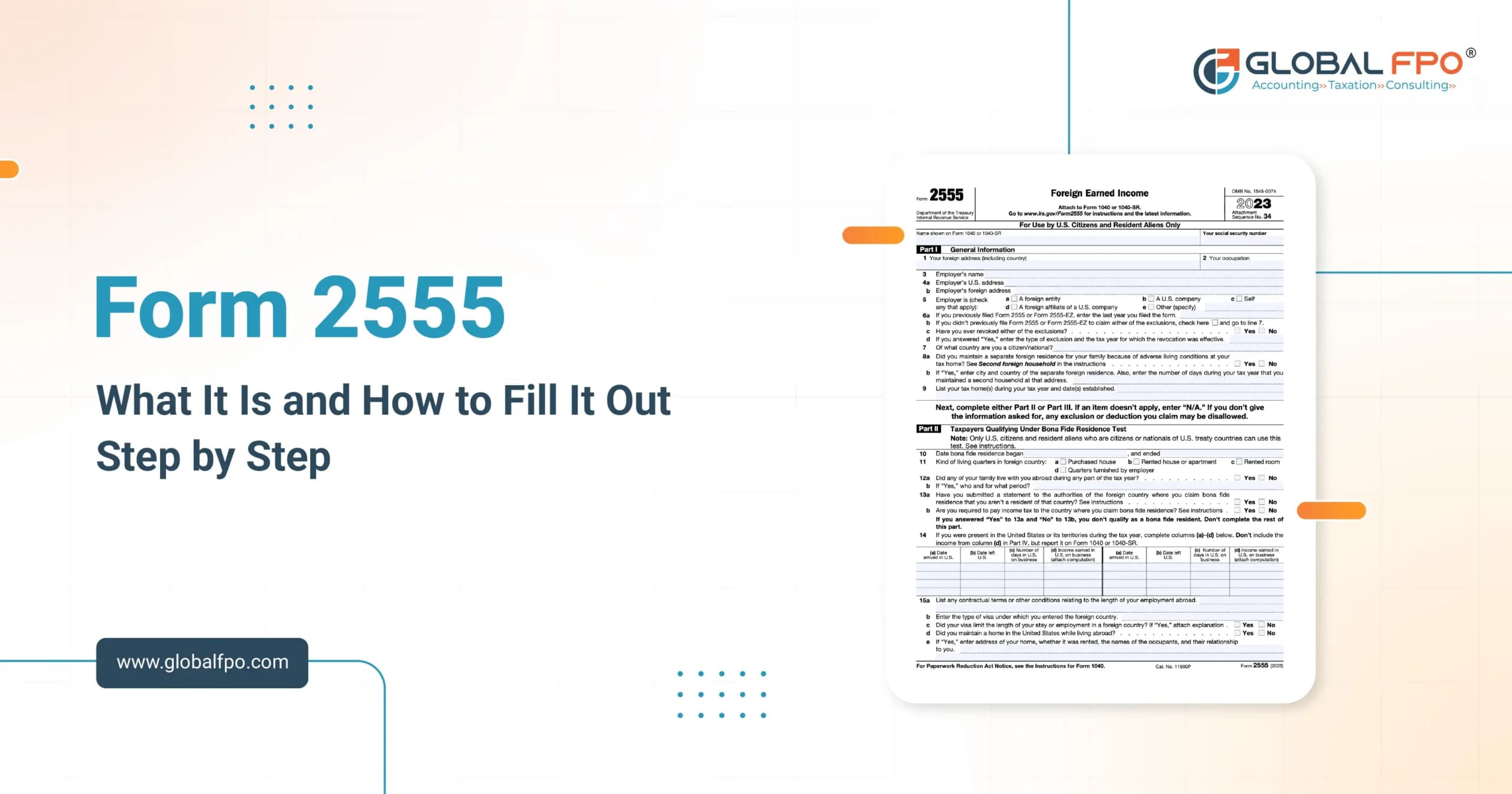
It is an IRS tax form that allows US citizens and resident aliens to exclude foreign earned income from federal taxation, helping reduce or eliminate double taxation. Filing form 2555 IRS correctly ensures your foreign income is reported in compliance with US tax laws while claiming the maximum benefit.

IRS Form 2555 applies to individuals whose tax home is outside the United States, regardless of who pays their salary. Using form 2555 foreign earned income properly can save significant amounts in taxes and prevent costly errors.

Eligible taxpayers include US citizens, green card holders, and resident aliens who live and work abroad for part or all of the tax year. Even short-term assignments can qualify under specific rules if the tests are met

Who Should File Form 2555

Form 2555 IRS is required for taxpayers earning income abroad who maintain a foreign tax home. This includes:

  • Employees of foreign companies
  • Contractors or freelancers working internationally
  • Self-employed professionals earning overseas

The IRS recognizes income as foreign earned only if you meet one of two tests: Physical Presence or Bona Fide Residence. Passive income like dividends, interest, and rental income is excluded. Correctly identifying eligibility prevents disallowed exclusions and reduces audit risk.
Other considerations:

  • Failure to meet tests disqualifies the exclusion
  • Annual exclusion limit is $126,500 for 2024
  • Accurate planning ensures all income is reported and documented

Foreign Earned Income Exclusion

The foreign earned income exclusion reduces taxable income for qualifying taxpayers. For 2024, up to $126,500 can be excluded. Only earned income qualifies, including:

  • Wages and salaries
  • Bonuses and commissions
  • Self-employment income

Passive income, such as dividends or rental income, does not qualify. Housing costs may also be excluded above the IRS base limit if documented properly. Misreporting income or housing can trigger audits or reduce benefits.

Tips for accurate reporting:

  • Classify income correctly according to IRS guidelines
  • Maintain housing receipts, leases, and rent statements
  • Use professional guidance to avoid mistakes

Physical Presence Test vs Bona Fide Residence Test

To file form 2555, you must meet one of two IRS qualification tests: the Physical Presence Test or the Bona Fide Residence Test.

Physical Presence Test

  • You must be physically outside the United States for at least 330 full days within a consecutive 12-month period.
  • Partial travel days do not count, and keeping a detailed travel log is essential.
  • This test works well for contractors and frequent travelers.

Bona Fide Residence Test

  • Requires you to reside in a foreign country for an entire tax year.
  • The IRS evaluates intent, local ties, and living situation.
  • Best for long-term expatriates with extended assignments.
Criteria Physical Presence Test Bona Fide Residence Test
Time Requirement 330 full days abroad Entire tax year
Residency or Intent No intent required Intent and residency required
Best For Frequent travelers, contractors Long-term expatriates

Choosing the wrong test can invalidate the foreign earned income exclusion. Careful evaluation is necessary before filing.

Documents Needed Before Filing Form 2555

Preparation prevents errors and delays when filing form 2555 IRS. Key documents include:

  • Passport stamps and travel logs
  • Foreign income statements
  • Employer letters and assignment details
  • Housing expense records (rent, utilities, employee-provided housing)
  • Invoices and receipts for self-employed taxpayers

Currency conversion records must follow IRS-approved rates. Misreporting foreign income due to incorrect conversions is a common reason for audits. Having documents organized ensures smoother filing and faster processing.

Part I

Part I captures taxpayer information: name, SSN, and foreign address. Establishing your foreign tax home is required here. Accuracy is crucial, as errors impact the rest of the form.
Tips for Part I:

  • Verify foreign address matches official records
  • Ensure dates of foreign residence are correct
  • Temporary assignments may not qualify as a tax home

Proper completion of Part I sets the stage for a successful filing. Errors can delay processing or disallow exclusions.

Part II: Qualification Details

Part II establishes eligibility under the selected test. You must provide exact travel or residncy permits, leases, or employer letters, str ency dates that match your documentation. Supporting documents, like reside engthen your claim.

Additional guidance:

  • Bona Fide Residence Test requires intent evidence
  • Physical Presence Test requires a travel log for 330 full days
  • Small discrepancies can trigger IRS inquiries

Proper Part II completion maximizes exclusions and reduces audit risk. Combining accurate records with professional review ensures a smooth filing.

Part III: Reporting Foreign Earned Income

Part III reports earned income and converts it to US dollars using IRS-approved exchange rates. Only earned income qualifies; passive income must be excluded. Accurate reporting prevents disallowed exclusions.

Examples of reportable income:

  • Wages, salaries, and bonuses
  • Self-employment income earned abroad
  • Professional fees

Tips:

  • Verify all amounts with pay slips and invoices
  • Use tables or accounting software to avoid errors
  • Double-check currency conversions

Part IV: Calculating Exclusion and Housing Benefits

Part IV calculates the foreign earned income exclusion, prorated for partial-year eligibility. Full-year residents may claim the maximum limit. Part V calculates the housing exclusion, which applies to expenses above the IRS base amount.

Eligible housing expenses:

  • Rent and utilities
  • Employer-provided housing
  • Other necessary housing costs

Tips

  • Housing limits vary by city; consult IRS tables
  • Luxury or non-essential expenses are excluded
  • Professional review ensures correct calculations

Common Filing Mistakes

Common mistakes with form 2555 IRS include:

  • Miscounting qualifying days
  • Incorrect currency conversions
  • Misreported income
  • Missing signatures or attachments
  • Filing separately from Form 1040

Other issues:

  • Confusing foreign earned income with passive income
  • Failing to meet eligibility tests
  • Late filing or missing deadlines

Avoid these errors through careful documentation and professional guidance. Correct filing reduces audit risk and ensures maximum benefit.

Filing Deadlines and Extensions

Form 2555 IRS is filed with Form 1040, due April 15. Expats receive an automatic extension to June 15, though interest accrues on taxes owed. Further extensions require Form 4868.

Tips to meet deadlines:

  • Track all due dates carefully
  • Prepare documentation early
  • Plan for partial-year exclusions if applicable

Timely filing protects your benefits and ensures IRS compliance. Professional assistance simplifies deadline management.

How Global FPO Supports Form 2555

Global FPO provides end-to-end support for expatriate tax compliance. Our services include form 2555 instructions, eligibility assessment, and accurate income reporting. We review travel records, housing costs, and calculate both income and housing exclusions.

We reduce audit risk and ensure documentation aligns with IRS rules. Complex filings become simple and accurate with professional oversight. Clients gain clarity, confidence, and maximum tax savings.

Global FPO also offers guidance on tax planning, extensions, and amended filings. Whether self-employed, a contractor, or a salaried employee abroad, our team provides personalized support. Filing form 2555 IRS correctly is critical, and we make the process seamless.

Filing Form 2555 With Confidence

Form 2555 offers substantial tax savings but requires careful attention and documentation. Errors or omissions can lead to disallowed exclusions, interest, or penalties. Professional support from Global FPO ensures accurate, compliant filings while maximizing benefits.

Accurate completion protects your tax savings and ensures IRS compliance. From eligibility assessment to income reporting and housing calculation, professional guidance simplifies every step. Filing form 2555 IRS correctly gives expats confidence and peace of mind.

FAQs

Que: 1. What is Form 2555 used for?

Ans. It allows US taxpayers to claim the foreign earned income exclusion and reduce taxable income

Que: 2. Who needs to file Form 2555?

Ans. US citizens or resident aliens earning income abroad who meet either the Physical Presence or Bona Fide Residence test.

Que: 3. Can Form 2555 be filed electronically?

Ans. Yes, it can be e-filed along with Form 1040.

Que: 4. Does self-employment income qualify?

Ans. Yes, if the income is earned abroad and meets IRS requirements.

Que: 5. Is housing exclusion automatic?

Ans. No, it must be calculated separately based on actual foreign housing expenses.

Que: 6. What is the maximum foreign earned income exclusion?

Ans. For 2024, it is $126,500; this amount adjusts annually for inflation.

Que: 7. What if I do not meet either eligibility test?

Ans. You may still claim foreign tax credits using Form 1116 instead.

Que: 8. Can Form 2555 be amended after filing?

Ans. Yes, through an amended Form 1040 with an updated Form 2555 attached.

Que: 9. What documentation is required to file Form 2555?

Ans. Travel records, foreign income statements, employer letters, and housing receipts or invoices are essential.

Que: 10. What happens if I file Form 2555 incorrectly?

Ans. Errors can lead to disallowed exclusions, delays in refunds, or IRS notices.

Tags:

Ask AI for a summary of Global FPO

chatgpt perplexity gemini claude Grok
skype-icon
Skype Call

Lets Connect

instagram-icon
facebook-icon
twitter-icon
linkedin-icon
youtube-icon
contact us form